Quick Answer
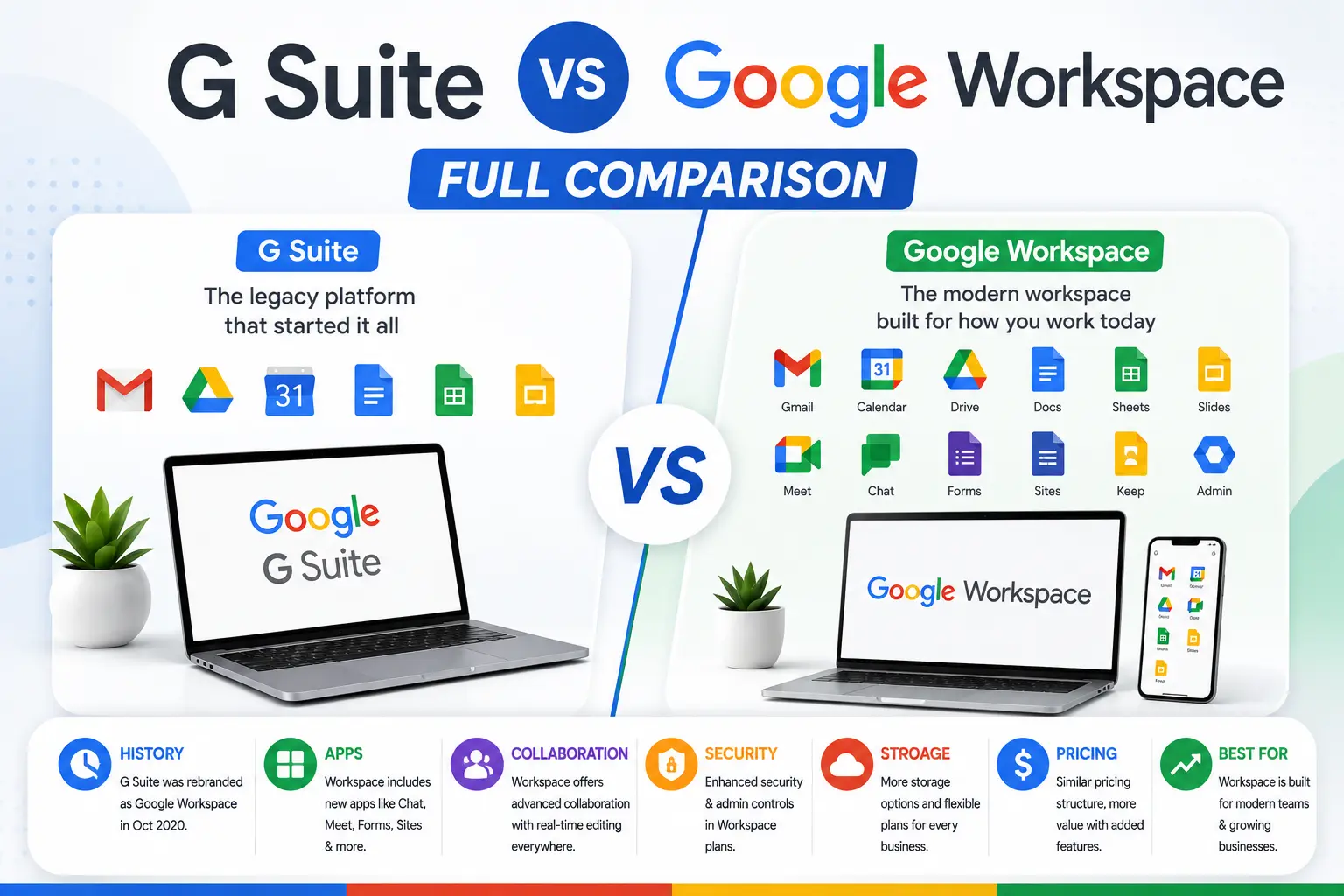
Google Suite (correctly called G Suite) and Google Workspace are the same product under two different names. Google rebranded G Suite to Google Workspace in October 2020, and the change went beyond a new logo; it introduced a more unified interface, new collaboration features, and eventually Gemini AI. Pricing has stayed structurally similar: what was G Suite Basic is now Business Starter at $7 per user per month, and G Suite Business is now Business Standard at $14 per user per month. If you’re still running the discontinued G Suite legacy free edition, that’s a separate, more urgent situation. Google has been actively enforcing its shutdown as recently as 2026, and accounts still on it risk suspension.
Google Suite vs Google Workspace: The Short History
The confusion around “Google Suite” (a common misnomer; the official name was always G Suite) versus Google Workspace comes down to a straightforward rebrand, but the product’s naming history goes back further than most people realize. It started as Google Apps for Your Domain in 2006, became Google Apps for Work, was renamed G Suite in 2016, and finally became Google Workspace in October 2020. Through all of that, the underlying idea stayed consistent: custom-domain email plus a suite of collaboration apps.
What Actually Changed in the 2020 Rebrand
This wasn’t purely cosmetic. Alongside the name change, Google unified its previously separate apps into a more integrated interface, introduced smart chips that surface a person’s contact details and quick actions (start a video call, send an email) when mentioned inside a document, and began tightening integration between Meet, Chat, and the core productivity apps. In the years since, Gemini AI has been built directly into the suite, something that didn’t exist under the G Suite name at all.
G Suite vs Google Workspace: Plan Name Changes
| Old G Suite name | Current Google Workspace name | Price (per user/month) |
|---|---|---|
| G Suite Basic | Business Starter | $7 |
| G Suite Business | Business Standard | $14 |
| G Suite Enterprise | Enterprise Standard / Enterprise Plus | Custom pricing |
If you’re comparing “G Suite Basic vs Google Workspace” or “G Suite Business vs Google Workspace Business Standard,” you’re really just looking at the same plan under its current name. The rebrand also introduced Business Plus as a new tier between Standard and Enterprise, something G Suite’s structure didn’t have.
Are You Still Paying G Suite Pricing?
If your business has been on the same subscription since before 2020 and hasn’t actively changed plans, you may still be on legacy G Suite pricing rather than current Workspace rates. It’s worth checking your Admin Console billing section directly, since staying on an old legacy paid plan isn’t necessarily cheaper, and it can mean missing features that only ship on current Workspace editions.
G Suite Legacy Free Edition: A More Urgent Issue
This is a genuinely different situation from the plan-renaming most people are asking about, and if it applies to you, it’s worth acting on directly rather than treating this as a naming curiosity.
What the legacy free edition was
Before December 2012, Google offered a free version of its custom-domain service, originally called Google Apps Standard Edition. Anyone who signed up before that date was allowed to keep using it for free, even as the product was renamed to G Suite and later Google Workspace around them.
The 2022 shutdown attempt
In January 2022, Google announced it would discontinue the G Suite legacy free edition entirely, requiring every remaining account to upgrade to a paid Workspace subscription or lose access. The announcement caused significant backlash; some businesses and families had relied on free accounts for over a decade, and Google delayed and adjusted the rollout multiple times in response.
It’s happening again in 2026
As recently as May 2026, Google resumed actively enforcing this shutdown, sending emails to remaining legacy free edition holders warning that Gmail, Drive, Calendar, and Meet will be suspended within 45 days unless the account is upgraded to a paid plan or a successful appeal is filed. Google states the enforcement targets accounts flagged for commercial use, but some users report personal and family domains being swept up as well, and the underlying dispute, including a federal lawsuit over an alleged “free for life” promise made to early adopters, remains unresolved. If your organization is still on this legacy tier, this isn’t a hypothetical future risk, it’s an active enforcement effort, and confirming your account status directly in the Admin Console is worth doing now rather than waiting for a notice.
Is Google Workspace Free?
Aside from the discontinued legacy tier discussed above, Google Workspace itself isn’t free on an ongoing basis. A 14-day free trial is available, and eligible nonprofits and educational institutions can access free or discounted tiers through separate programs, but standard business use requires a paid subscription starting at $7 per user per month.
Google Workspace vs Microsoft 365
Since the rebrand, Google Workspace has continued to compete directly with Microsoft 365 on similar ground: both offer email, document collaboration, and video meetings at broadly comparable price points, with Microsoft including desktop Office apps that Google’s browser-first suite doesn’t, and Google generally offering faster, simpler real-time collaboration. Businesses evaluating both after outgrowing an old G Suite plan often find this the more relevant comparison than the historical naming question.
Google Workspace vs Google Drive
It’s also worth clarifying a related but different confusion: Google Drive is one component within Google Workspace, the file storage and sharing layer, not a separate competing product. A free personal Google Drive account (15 GB) is different from Drive as part of a paid Workspace subscription, which includes pooled organizational storage starting at 30 GB per user and scaling much higher on upper tiers.
Google Workspace Pros and Cons
Pros: unified, actively developed platform with Gemini AI built in; real-time collaboration that remains best-in-class; regular feature updates since the rebrand that G Suite never received.
Cons: businesses still on old legacy pricing may face a real transition if they’ve delayed updating; the shift from a familiar “G Suite” name continues to cause search and documentation confusion years later; and, as covered above, anyone still holding a legacy free account faces an active, unresolved enforcement situation.
What to Do If You’re Still Using the “G Suite” Name Internally
For businesses whose invoices, documentation, or internal references still say “G Suite,” this is worth updating for clarity alone, since the name hasn’t existed as a distinct product since 2020, and continuing to search for or reference it can lead to outdated pricing and support information. If your team is evaluating whether your current plan still fits, comparing your legacy plan’s actual features against current Google Workspace pricing and tiers is a reasonable way to confirm whether an upgrade path makes sense.
Common Mistakes to Avoid
- Searching for “Google Suite” as if it’s a separate, currently available product. It isn’t; the correct historical name was G Suite, and it’s now Google Workspace.
- Assuming a legacy free G Suite account is safe long-term. Google has actively resumed enforcement of its shutdown as recently as 2026.
- Confusing G Suite plan names with current ones when comparing old documentation or invoices against today’s pricing.
- Treating Google Drive as a separate product from Workspace rather than one component within it.
- Assuming nonprofit or education pricing changed during the 2020 rebrand; it didn’t.
The Bottom Line
Google Suite, correctly G Suite, and Google Workspace are the same product; the 2020 rebrand changed the name, unified the interface, and eventually added Gemini AI, while the pricing structure carried over under new plan names. The one situation that genuinely needs attention rather than just clarification is the G Suite legacy free edition, which Google has been actively shutting down since 2022 and is enforcing again as of 2026. If that applies to your account, checking your Admin Console and confirming your options is worth doing before a suspension notice forces the decision. For everyone else simply trying to understand what changed, the short version is: same product, new name, genuinely more capability than it had before.
FAQ
Is Google Suite the same as Google Workspace?
Yes. Google Suite, correctly called G Suite, was rebranded to Google Workspace in October 2020. No separate product exists under the old name.
What happened to G Suite Basic and G Suite Business?
They were renamed. G Suite Basic became Business Starter at $7 per user per month, and G Suite Business became Business Standard at $14 per user per month.
Is G Suite legacy free edition still available?
No, new signups closed in 2012, and Google has been actively shutting down remaining free accounts since 2022, with renewed enforcement as of 2026 requiring an upgrade to a paid plan.
What happens if I don’t upgrade my G Suite legacy free account?
Google has been sending 45-day suspension warnings to remaining legacy free edition holders, after which Gmail, Drive, Calendar, and Meet access can be cut off unless the account is upgraded or a successful appeal is filed.
Is Google Workspace free?
Not for standard business use, aside from a 14-day trial. Eligible nonprofits and educational institutions can access separate free or discounted programs.
Did the G Suite to Google Workspace rebrand change pricing?
Standard business pricing carried over structurally under new plan names. Nonprofit and education pricing wasn’t affected by the 2020 change.
Is Google Drive part of Google Workspace or a separate product?
Google Drive is a component within Google Workspace, the file storage layer, not a separate competing product.